
The Nobel Prize-winning molecule that is reversing aging in research.
Oxidation is what browns a cut apple and what ages you from the inside. Carbon 60 absorbs the molecules driving it. In a 2012 study, rats given C60 dissolved in olive oil lived nearly twice as long, with no toxicity or side effects.

What is C60?
- C60, or Carbon 60, is a molecule of sixty carbon atoms arranged in a hollow ball. Discovered in 1985 and won the Nobel Prize in Chemistry in 1996.
- In your body it works as an antioxidant, neutralizing the free radicals that damage your cells as you age.
- Unlike vitamin C, it does not get used up. A single C60 molecule has 172 times the antioxidant activity of vitamin C.
- Reported benefits include more energy, better sleep, sharper focus, easier joints, faster recovery, healthier skin and stronger immune function.
- In the 2012 study, rats given C60 in olive oil lived far longer than those without it, and no toxic dose was found.
- C60 does not dissolve in water, so it is taken in oil. Olive, avocado, coconut MCT and hempseed are the common carriers.
- One teaspoon a day, taken consistently. Benefits are noticeable over weeks rather than overnight.
What are the benefits of C60?
Oxidative damage affects your whole body, so reducing it can have widespread benefits
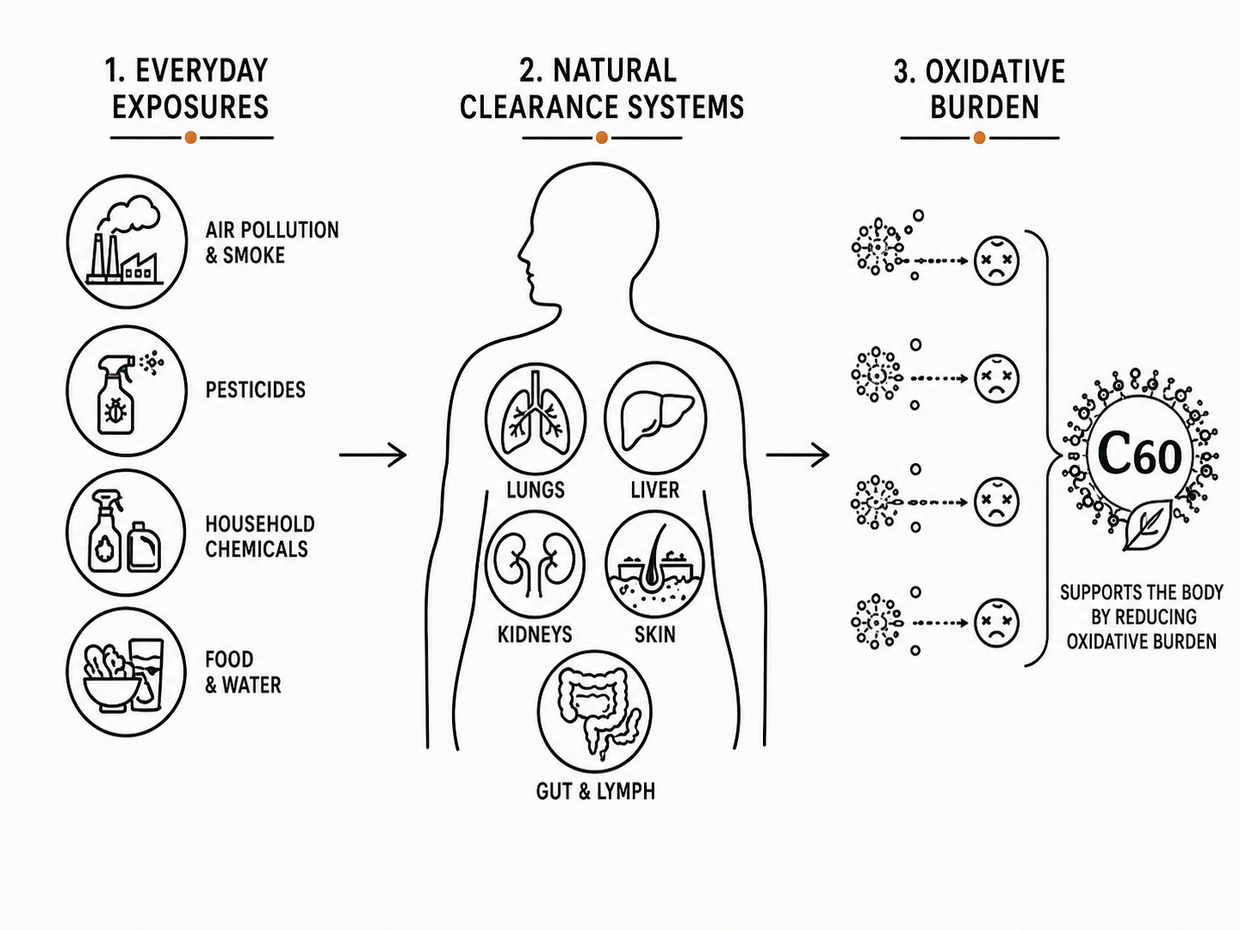
Slows the effects of aging
Free radicals are one of the biggest drivers of aging. C60 helps neutralize them before they accumulate and damage your cells.
Increases energy
Your mitochondria produce your body's energy, while taking free radical damage in the process. C60 helps counter free radicals the moment they form, inside the mitochondria where they are made.
Improves sleep
Better sleep is among the most common things long-term users report, often within the first few weeks.
Sharpens focus and memory
Your brain uses more oxygen than any other organ of its size, making it especially vulnerable to oxidative stress. C60 dissolves in fat, which is why it can cross the blood-brain barrier and help reduce that burden.
Eases joints and inflammation
Oxidative stress and long-term inflammation reinforce each other. By neutralizing free radicals, C60 helps interrupt that cycle, and reduced joint discomfort is one of its consequences.
Improves strength and recovery
Hard training creates free radicals directly, which is a part of why you ache afterwards. Animal studies have shown C60 protecting muscle tissue under stress and supporting faster recovery. Athletes report better performance and motivation.
Supports healthier skin
Your skin is constantly exposed to UV light and pollution, as part of modern life. C60 has been studied as a skincare ingredient for helping protect against that damage and improving skin appearance.
Supports immune function
Immune cells generate reactive molecules as part of their job, exposing them to constant oxidative stress. By neutralizing excess free radicals, C60 supports healthy immune function.
None of these are direct effects of C60. C60's primary role is reducing oxidative damage, which is what gives rise to these benefits.
What did the famous C60 study actually find?
In 2012, a French research team led by Tarek Baati and Fathi Moussa published the study that started this entire category. They were not testing C60 for longevity. They were trying to find the dose at which C60 became harmful.
They split Wistar rats into groups. One group got water. One got plain olive oil. One got olive oil with C60 dissolved in it. Then they tracked the animals and analyzed their blood, urine and tissue.
The plain olive oil group lived around 30% longer than the water group. The group given C60 in olive oil lived close to 90% longer, roughly twice as long as the control animals.
They never found the toxic dose they were looking for. No acute or subacute toxicity appeared at any concentration tested. Rodent research across the field since then has reported lifespan increases between 35% and 100%.
How does C60 work in the body?
The secret is in the shape
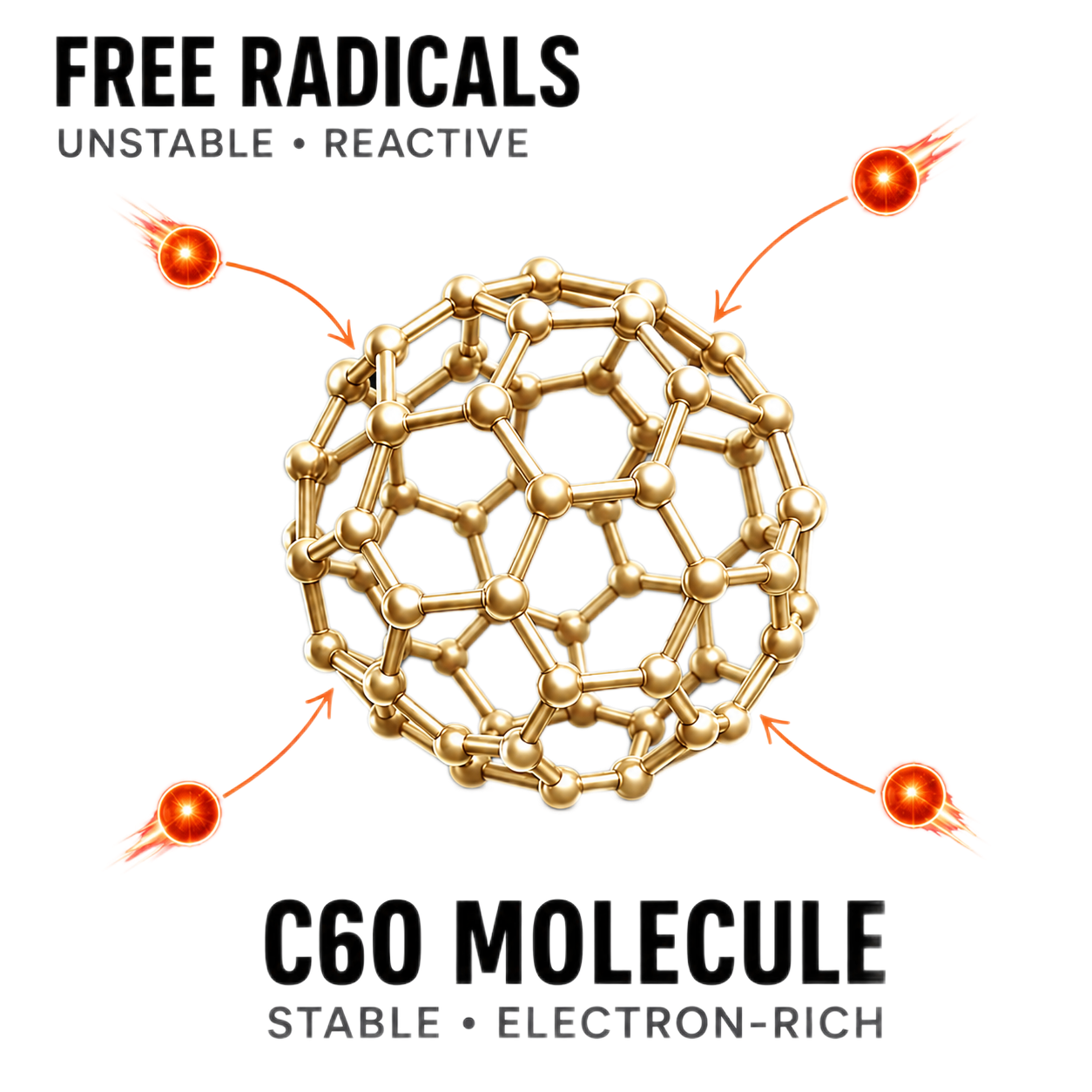
Those sixty carbon atoms form a closed cage of 20 hexagons and 12 pentagons, the same pattern as a soccer ball. The cage carries around thirty reactive double bonds and can hold up to six extra electrons.
That unique shape lets it absorb free radicals one after another without breaking down, earning it the nickname "free radical sponge," coined by researcher P.J. Krusic.
This repeated action is what gives C60 its reported antioxidant activity of up to 172 times that of vitamin C.
Where it goes once you take it
C60 dissolves in fat, which means it crosses the blood-brain barrier, and it builds up inside mitochondria. Mitochondria are where most of your free radicals are created, so that is a good place for any antioxidant to end up at. Researchers have also observed a second effect, where C60 reduces how many free radicals get made in the first place by slightly loosening the energy-production process in mitochondria.
Is C60 better than other antioxidants?
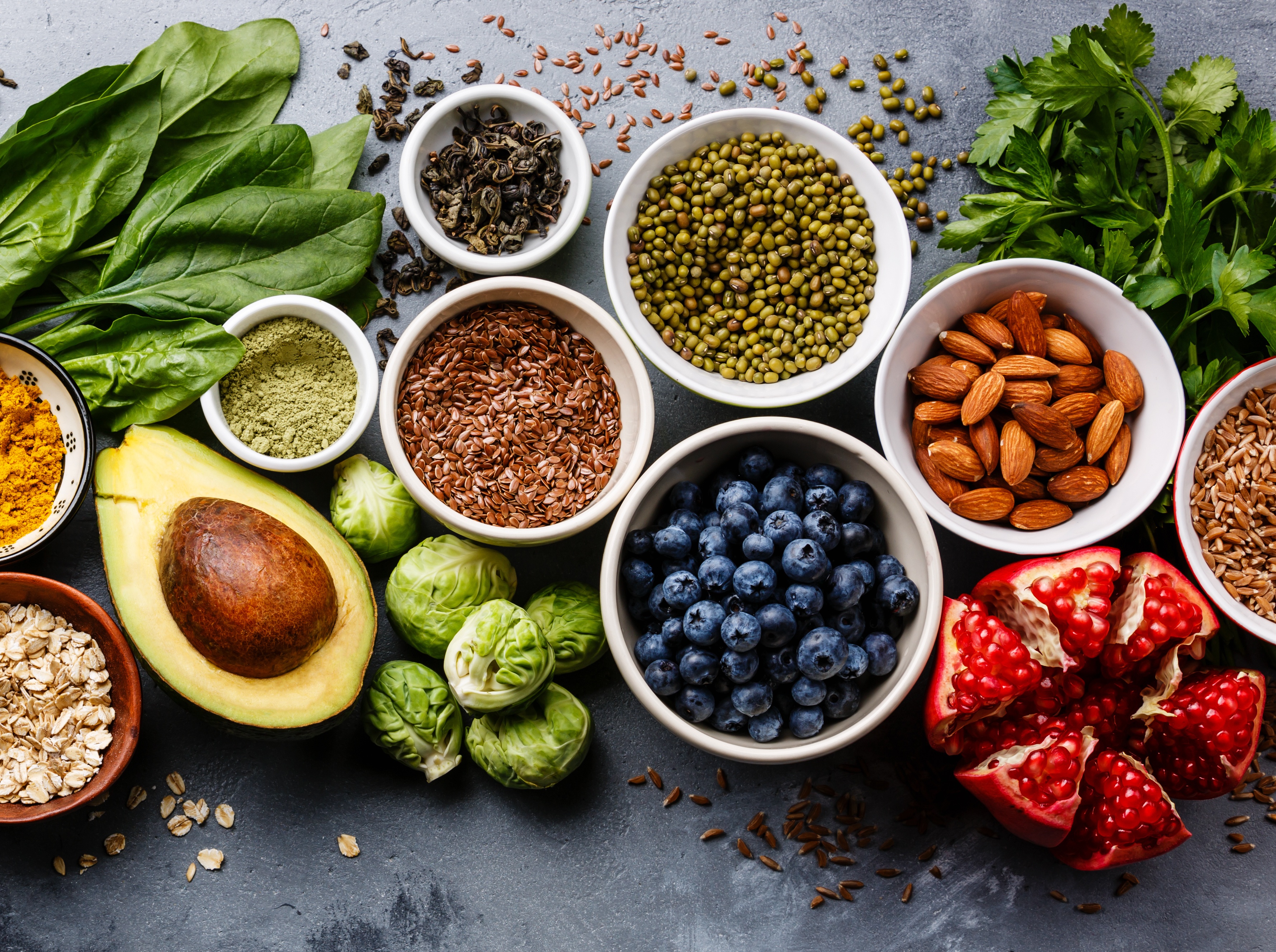
Berries, matcha and greens
Real antioxidant content, and worth eating. The problem is that most of it is broken down before it reaches your bloodstream, and what does get through still neutralizes one free radical per molecule.
Vitamin C
Dissolves in water, so it works in the watery parts of your cells and struggles to reach fatty membranes and mitochondria. Each molecule handles one free radical and is then spent.
Vitamin E
Dissolves in fat, so it protects cell membranes better than vitamin C does. Vitamin E is still used up on contact, and it needs vitamin C or glutathione to be recycled before it can work again.
C60 sits in a different category because it is reusable. That does not make the others pointless. No single antioxidant handles every type of free radical, and your body runs several overlapping defense systems for a reason. C60 is something you add to a good diet, not a one-size-fits-all fix.
C60 vs. other longevity supplements.
CoQ10, astaxanthin, resveratrol, glutathione and NMN are the five C60 gets measured against most often. Here is how they line up.
See the full comparison table
| Metric | C60 | CoQ10 | Astaxanthin | Resveratrol | Glutathione | NMN |
|---|---|---|---|---|---|---|
| Antioxidant potency vs. vitamin C | 172x | Moderate | 6,000x (singlet O₂) | Low (indirect) | High (master recycler) | N/A (not direct) |
| Mechanism | Radical sponge (reusable) | Single-use electron donor | Single-use electron donor | Sirtuin activation | Recycler of other antioxidants | NAD+ precursor |
| Reusable? | Yes (absorbs dozens) | No | No | No | Partially (recycled) | N/A |
| Crosses blood-brain barrier | Yes | Limited | Limited | Yes (limited amount) | No | Indirect (via NAD+) |
| Mitochondrial accumulation | Yes (preferential) | Yes (primary role) | No | Indirect | Yes (synthesized there) | Indirect (via NAD+) |
| Bioavailability | High (in oil) | Moderate (ubiquinol better) | Good (fat-soluble) | Very poor | Poor (oral); better liposomal | High (Slc12a8 transporter) |
| Key longevity study | 90% lifespan increase (rats, 2012) | Heart failure benefits (human) | Cognitive function (human) | 30% lifespan (invertebrates) | Immune and detox (human) | NAD+ doubling (human) |
| FDA status | Dietary supplement | Dietary supplement | Dietary supplement | Dietary supplement | Dietary supplement | Removed from supplement list (US) |
| Best for | Deep cellular protection | Heart and energy | Joints and skin | Cardiovascular and aging pathways | Liver and immune detox | NAD+ and energy restoration |
| Typical daily cost | $1.50 to $3.00 | $0.30 to $1.00 | $0.50 to $1.50 | $0.25 to $0.75 | $0.75 to $2.00 (liposomal) | $1.00 to $3.00 |
Swipe the table sideways
These work on different systems, so most people stack them rather than choose between them. C60 handles free radical load; NMN and resveratrol work on repair and signalling.
So why isn't C60 popular?
A molecule with a Nobel Prize and 40+ years of research, has no celebrity backing it, no big podcast talking about it, and almost no presence in normal supplement conversations. There are two reasons, and neither has anything to do with its performance.

1 It was too expensive
A normal daily serving of C60 is one teaspoon, four to five millilitres. So a 4oz bottle lasts roughly a month. Athletes and serious biohackers take two teaspoons a day, which means two bottles a month.
Most of this category charges more than $100 for a 4oz bottle. So a normal serving costs over $100 a month, and an athlete serving costs over $200 a month, every month, for something your doctor has probably never mentioned.
At that price, C60 remained a niche supplement reserved for serious longevity enthusiasts.
Everyone else looked at the price and moved on, so C60 never got the word of mouth that cheaper supplements did.
2 The cheap version isn't made for consumption
Most C60 in the world is made for electronics and materials science. That grade is cleaned using chemical solvents like toluene, which then have to be removed again. Leftover solvent is the contamination risk most people worry about.
The proper method is sublimation. The solid C60 is heated in a vacuum until it turns straight into vapor and comes back down as clean material, with no liquid chemicals involved at any point. It is slower, costs more, and the only right way to produce C60 for human consumption.
C60 is not an FDA-regulated ingredient, so nobody is forced to prove which method they used. A purity percentage can sit on a label either way. That is why it is worth looking at how a company makes its C60 rather than what its bottle says.
How do you choose a good C60 oil?
Since nobody is required to prove anything, the label alone will not tell you much. Five things will.
99.99% purity, with proof behind it
Some brands list 99.95%, which allows up to five times more unidentified material in the same bottle. Neither number tells you what that material is, so ask whether a current certificate of analysis is available.
Sublimated, not solvent-cleaned
These are two separate questions. C60 can test very pure and still carry traces of the chemicals used to clean it, so look for the method stated outright rather than implied by a percentage.
Milligrams printed clearly
Purity describes the powder. Milligrams describe what you are getting. If a bottle publishes purity but not concentration, you could be getting very little C60.
Dark or UV-protective glass
C60 breaks down in light. Amber, violet or cobalt glass is “a chemical requirement, not a design choice.”
A price that makes sense
4oz of C60 oil sells for anywhere from $30 to over $100, and the chemistry does not explain that gap. Very cheap means solvent-cleaned industrial material. Very expensive means you are paying for marketing and distribution, rather than product quality.
C60 oils that Meet Every Standard
By now you've seen exactly what matters when choosing a C60 oil: 99.99% purity, sublimation instead of solvent cleaning, clearly stated C60 content, and UV-protective glass.
Every bottle we sell meets those standards.
But that naturally raises a question:
Why do some brands charge over $100 while ours starts at $54.95, drops to $41.21 with a subscription, and goes as low as $35.62 when bundled?
The answer isn't lower quality. It's a different business model.
Since 2016, we've been a family business selling directly to customers. We don't pay distributors, retailers, celebrity endorsements, podcast sponsorships, or large advertising budgets.
So you're paying for what's inside the bottle, not its marketing costs.
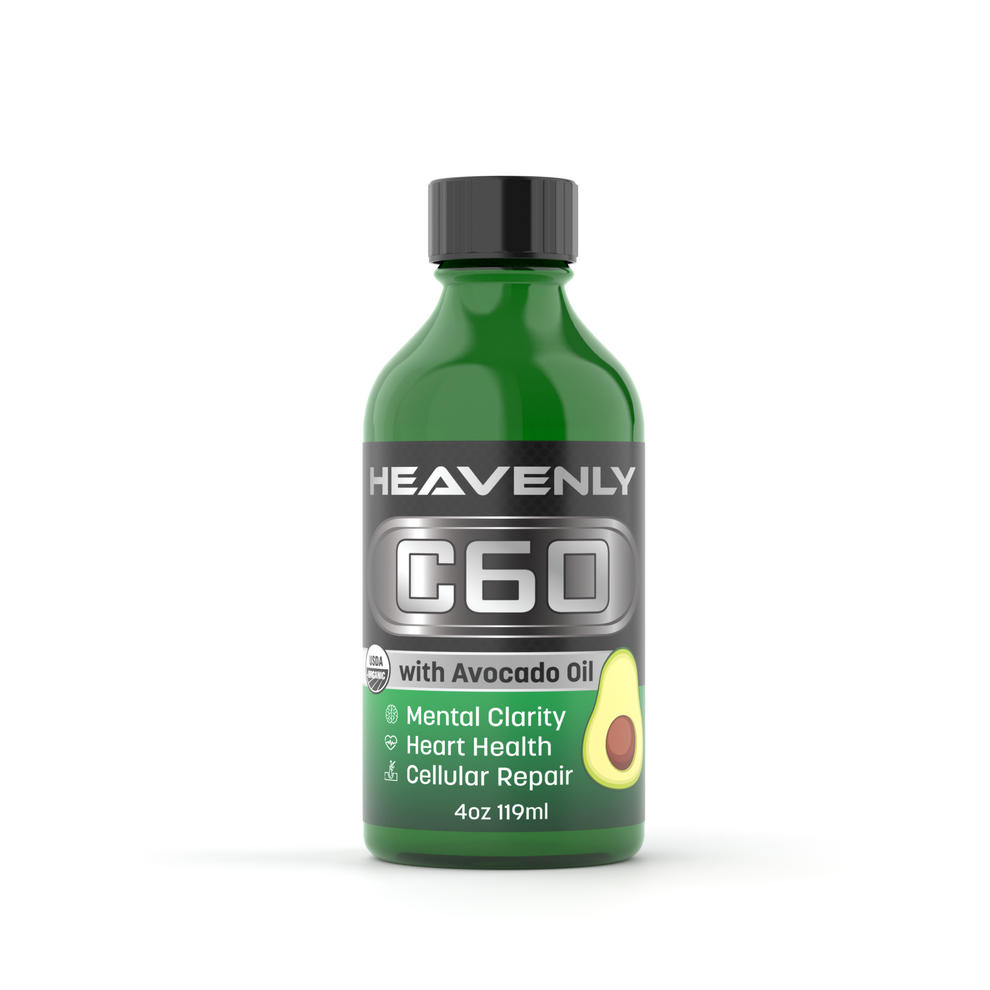
Gentlest option
Organic Avocado Oil
About 70% oleic acid and easy on a sensitive stomach. Mild enough to take straight off the spoon.
Learn more
88mg C60 · 4oz
Most C60 per bottle
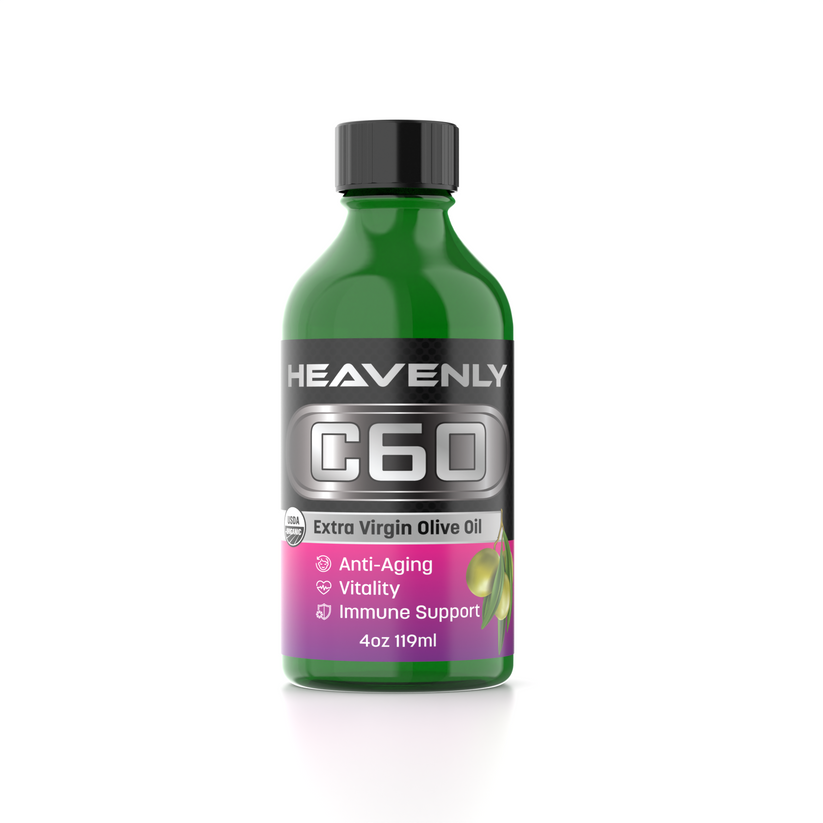
Organic Olive Oil
Holds more dissolved C60 than the other oils, and it is the carrier used in the 2012 study. Peppery, so most people take it with food.
Learn more
102mg C60 · 4oz
No taste
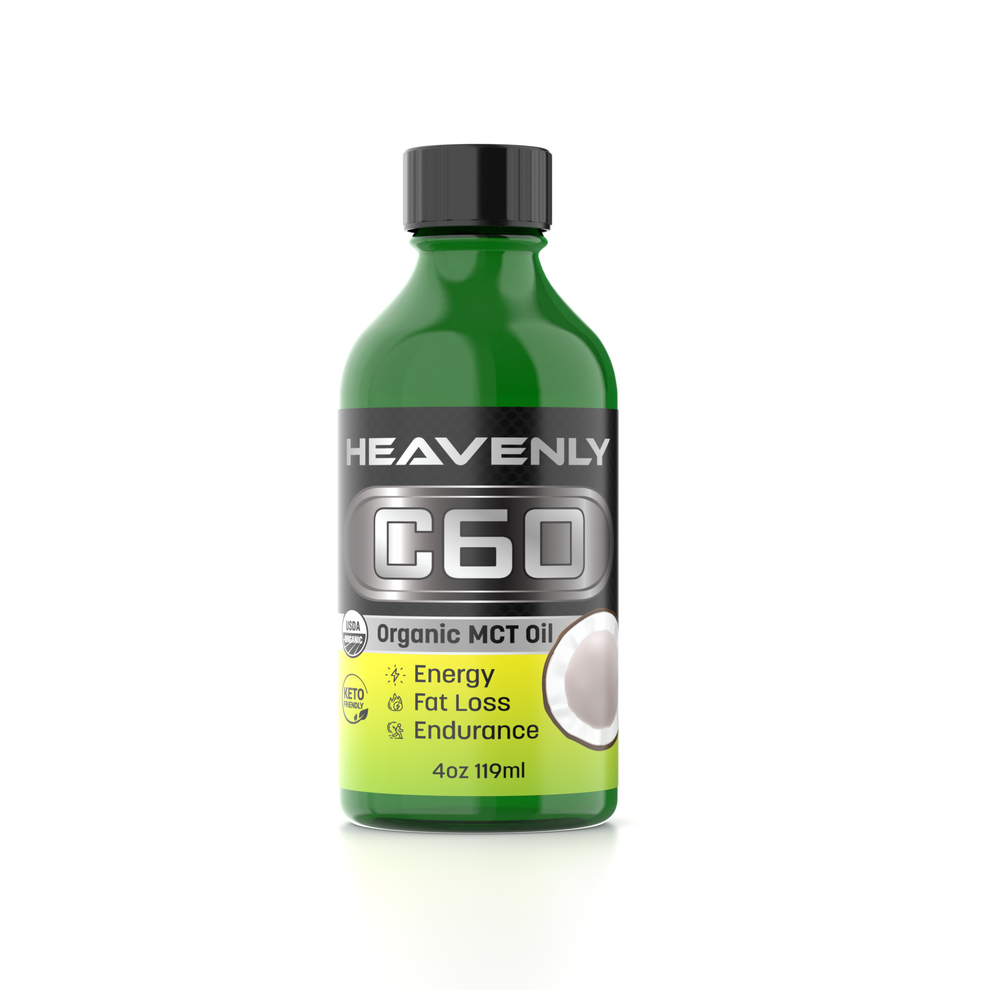
Coconut MCT Oil
Absorbs quickly and has almost no flavour, so it disappears into coffee. The usual pick for anyone during a fasting window.
Learn more
45.6mg C60 · 4oz
Own omega profile
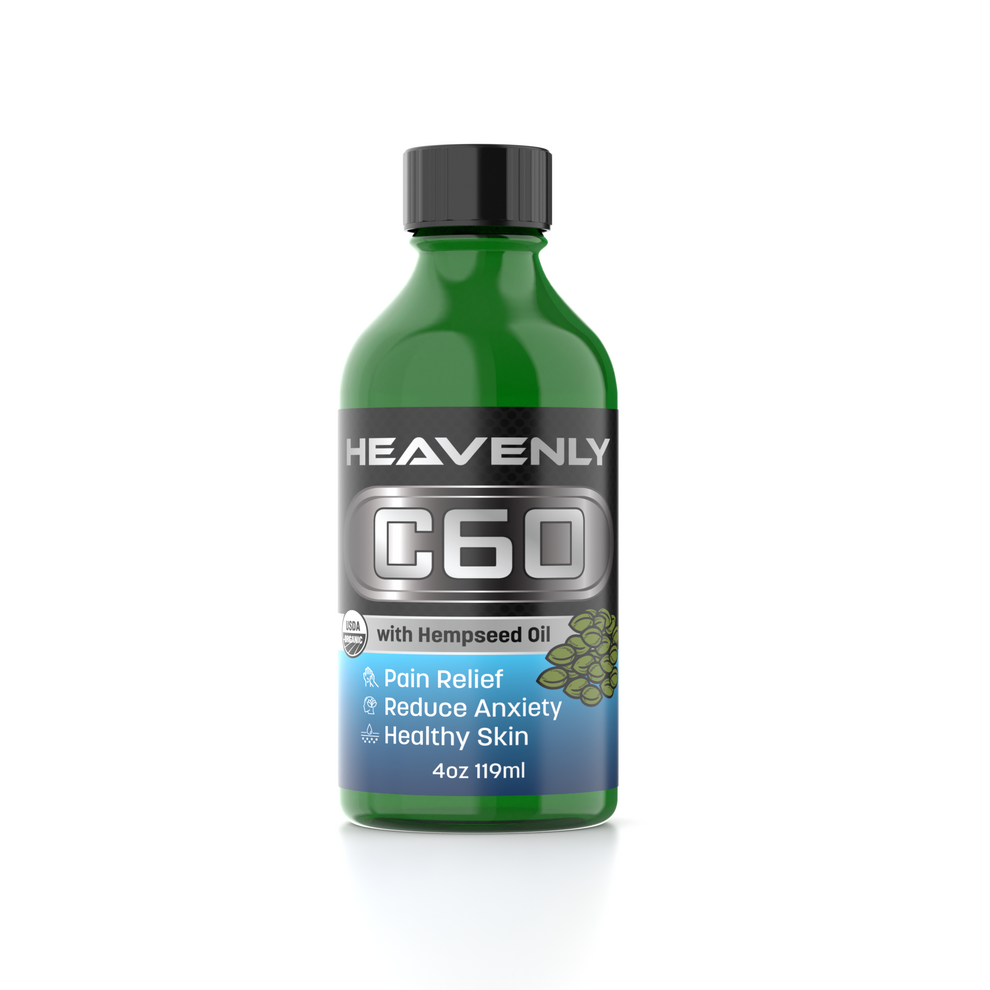
Organic Hempseed Oil
Brings its own omega-3 and omega-6 content. Grassy and distinctive, so it suits people already using hemp oils.
Learn more
99mg C60 · 4oz
Free shipping on US orders over $100. 30-day money-back guarantee for first-time customers. Made in the USA.
How much C60 should you take?
C60 is measured by the spoonful rather than the capsule. A four-ounce bottle holds about 118ml, which is what decides how long it lasts.
| Who it is for | Daily amount | One 4oz bottle lasts | What it does |
|---|---|---|---|
| General health | 1 teaspoon (4 to 5ml) | About 30 days | Clears the everyday free radical load. Standard serving and the right place to start. |
| Athletes and biohackers | 2 teaspoons (8 to 10ml) | About 15 days | For people aiming at performance and recovery rather than maintenance. Two bottles a month. |
How to take it
Straight off the spoon, or mixed into food or a drink if the taste of a stronger oil bothers you.
Keep it away from heat. Heat and light both break C60 down, so do not cook with it or add it to anything hot.
Take it every day
C60 clears from your system within a day or two, so daily use matters far more than the size of any one dose.
The benefits build up, so most people give it 1 to 3 months before deciding if it's working for them or not.
Common questions about C60.
What is C60 made of?
Sixty carbon atoms and nothing else, arranged in a hollow cage of twenty hexagons and twelve pentagons about a nanometer across. C60, Carbon 60, buckminsterfullerene and buckyball all mean the same molecule.
What are the main benefits of C60?
It clears free radicals, resulting in: more energy, better sleep, sharper focus, easier joints, faster recovery, healthier skin and better immune function.
Is C60 the same as activated charcoal?
No. Charcoal is a rough, porous material made of carbon atoms in no particular order. C60 is one molecule with an exact structure. Carbon is the only thing they have in common.
Why is C60 sold in oil instead of capsules?
C60 does not dissolve in water. It needs fat to dissolve and be absorbed, which rules out capsules, powders and drink mixes. “The oil is the delivery system, not an extra.”
Which oil should I choose?
Olive holds the most C60 and was the oil used in the 2012 study. Avocado is the gentlest on your stomach. MCT has almost no taste. Hempseed brings its own omegas. The C60 inside is identical in all four.
Can I take C60 with my other supplements?
C60 works on free radical damage, which is a different job from what NMN, resveratrol or glutathione do, so people usually add it to what they already take. Check with your doctor about your specific combination, especially alongside prescription medication.
How long does C60 take to work?
The effects build up rather than hitting at once. Most people take it daily for one to three months before judging it.
Does C60 oil need refrigerating?
No. A cool, dark cupboard away from heat and sunlight is enough. The glass handles the light; you handle the heat.
Are there side effects?
The 2012 rat study was designed to find a toxic dose and never found one, reporting no acute or subacute toxicity at any level tested. Some people notice mild digestive adjustment in the first few days of any new oil.
Is C60 banned in competitive sport?
C60 is not on the NCAA banned substances list. If you compete under a different governing body, check their current list yourself.